raincandy-u/MacroStories — model analysis
Summary
- Size: The model consists of about 20 thousand numbers (parameters). Its saved files total about 81KB.
- Structure: A dense model that uses all of its parameters for every input. About 60% of the parameters are assigned to the vocabulary dictionary (embedding), about 20% to the part that holds knowledge (FFN), and about 20% to the part that reads context (attention).
- Japanese text: This tokenizer cannot represent Japanese correctly. The fixed Japanese text (449 characters) was split into 35 tokens, but decoding them does not give back the original text. Of its 378 vocabulary entries, 0 contain kana or kanji. The fixed English text (1,201 characters) does not decode back to the original either.
- Context length: The limit written in the config (max_position_embeddings) is 2,048 tokens (not converted to characters, because neither fixed text decodes back to the original).
One line: Dense · ouro · 1 layers · 19.97K params · MQA · context 2,048 · vocab 378
Basic information
- Model: raincandy-u/MacroStories (revision
dc1ef998bf53, config.json) - License: not stated
- Declared base_model: none
- Storage dtypes: F32 19.97K
Architecture (stage 0)
Parameters by part
Counted from the tensor shapes in the safetensors headers (measured).
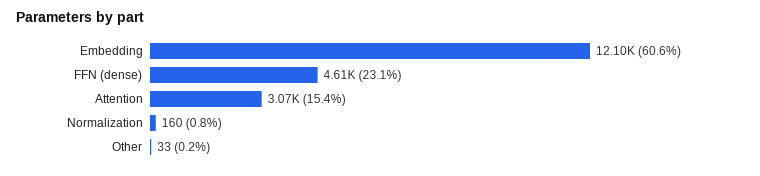
| Part | Parameters | Share |
|---|---|---|
| Embedding | 12,096 | 60.57% |
| FFN (dense) | 4,608 | 23.08% |
| Attention | 3,072 | 15.38% |
| Normalization | 160 | 0.80% |
| Other | 33 | 0.17% |
Structure
Values from config.json.
| Item | Value |
|---|---|
| model_type / architectures | ouro / OuroForCausalLM |
| Layers | 1 |
| Hidden size | 32 |
| FFN intermediate size (intermediate_size) | 48 |
| Attention type | MQA |
| Heads / KV heads / head dim | 2 / 1 / 16 |
| Sliding window | — (use_sliding_window=No) |
| Layer types (layer_types) | full_attention×1 |
| RoPE θ | 10,000 |
| RoPE scaling | — |
| Partial rotary (partial_rotary_factor) | — |
| Context length (max_position_embeddings) | 2,048 |
| Tied input/output embeddings | Yes |
| Activation | silu |
| Normalization ε | 1.000e-06 |
MoE configuration
Not applicable (not an MoE model).
config vs. actual tensors
Values in config.json side by side with the actual tensor shapes (measured).
| Item | config | Actual | Match | Source of actual |
|---|---|---|---|---|
| vocab_size | 378 | 378 | Yes | model.embed_tokens.weight |
| hidden_size | 32 | 32 | Yes | model.embed_tokens.weight |
| num_hidden_layers | 1 | 1 | Yes | largest layer index + 1 (excluding MTP layers) |
| num_key_value_heads×head_dim | 16 | 16 | Yes | model.layers.0.self_attn.k_proj.weight |
| num_attention_heads×head_dim | 32 | 32 | Yes | model.layers.0.self_attn.q_proj.weight |
| intermediate_size | 48 | 48 | Yes | model.layers.0.mlp.gate_proj.weight |
| tie_word_embeddings (no output-head tensor) | Yes | Yes | Yes | tensor list |
Tokenizer
Results of tokenizing the fixed Japanese and English texts (see conditions) without special tokens (measured). "Tokens splitting a character" is the share of tokens that decode to a broken character (U+FFFD) on their own.
| Text | Characters | Tokens | Chars/token | Bytes/token | Tokens splitting a character | Round-trips exactly |
|---|---|---|---|---|---|---|
| Japanese | 449 | 35 | 12.829 | 38.429 | 0.0% | No |
| English | 1,201 | 283 | 4.244 | 4.343 | 0.0% | No |
Of 378 vocabulary entries, 0 (0.00%) contain at least one kana or kanji character and 0 contain two or more (loaded with tokenizers).
Special tokens and chat format
7 special tokens. BOS: <|start_story|>, EOS: <|end_story|>. Chat template: none.
Thinking tags: No, tool calls: No, FIM: No, image tokens: No (found by searching special-token names and the template text).
List of special tokens
<|pad|>, <|start_story|>, <|end_story|>, <|unk|>, [PERSON_NAME_1], [PERSON_NAME_2], [PERSON_NAME_3]
Weights (stage 1)
Analyzed 15 of 15 tensors (compute time 0 s). Each tensor was converted to fp32 for computation.
Trends across layers
RMS is the root mean square of the elements. max|w| ÷ RMS is how many times larger the largest element is than a typical one. Excess kurtosis measures tail heaviness and is 0 for a normal distribution (all measured). The figures use weights with 2 or more dimensions (matrices) only; 1-D biases and similar are left out.
The model has only 1 layer, so the trends across layers are not plotted.
Matrices with the largest values (main-model weights with 2 or more dimensions): max|w| ÷ RMS 4.006 (model.layers.0.self_attn.v_proj.weight), excess kurtosis 1.245 (model.early_exit_gate.weight), outlier share 0.000% (model.early_exit_gate.weight).
Outliers and outlier channels
An outlier is an element exceeding 6 times the standard deviation of its matrix. For each matrix that takes the hidden dimension as input, the columns with the most outliers (top 16) were collected, and the number of layers in which each column appeared was counted (measured).
No such columns.
Normalization-layer weights
For each of the 5 normalization layers whose length equals the hidden size (32), the dimensions farthest from the median (top 16) were collected, and the number of normalization layers in which each dimension appeared was counted (measured).
| Dimension | Normalization layers it appeared in |
|---|---|
| 9 | 5 |
| 17 | 5 |
| 23 | 5 |
| 26 | 5 |
| 8 | 4 |
| 13 | 4 |
| 22 | 4 |
| 25 | 4 |
| 0 | 3 |
| 3 | 3 |
Dimensions shared with the top 10 outlier channels above: none.
Effective rank
Stable rank = (Frobenius norm)² ÷ (largest singular value)², divided by the matrix's shorter side to scale it to 0–1. The largest singular value is approximated by power iteration (30 steps) (estimated).
Stable rank ÷ shorter side by part:
| Part | Matrices | Min | Median | Max | Matrix with the minimum |
|---|---|---|---|---|---|
| Attention | 4 | 0.2456 | 0.2886 | 0.4705 | model.layers.0.self_attn.o_proj.weight |
| FFN (dense) | 3 | 0.294 | 0.3067 | 0.355 | model.layers.0.mlp.up_proj.weight |
| Embedding | 1 | 0.1594 | 0.1594 | 0.1594 | model.embed_tokens.weight |
Embedding rows
Distribution of the length (norm) of each vocabulary entry's embedding row, and the rows with the smallest norms (bottom 0.1%) (measured).
model.embed_tokens.weight (378 rows)
| Min | Bottom 0.1% | Bottom 1% | Median | Top 1% | Max |
|---|---|---|---|---|---|
| 0.5172 | 0.7176 | 1.1761 | 1.7968 | 3.0546 | 3.0548 |
Rows with small norms (1 row in the bottom 0.1%, smallest first): 1:'<|start_story|>'(0.5172)
A small norm does not mean that the token is unimportant or untrained.
Similarity between experts
Not applicable (not an MoE model).
Measurement conditions
- mbscope 0.2.12 (result schema v1), Python 3.14.4, torch 2.13.0+cu130, safetensors 0.8.0, huggingface_hub 0.36.2, tokenizers 0.21.4, transformers 4.49.0
- Estimation criteria: outlier_sigma=6.0, embed_low_pct=0.1, power_iters=30, sketch_dim=32, top_channels=16, seed=20261002
- Input texts: ja: Natsume Sōseki, I Am a Cat, opening (Aozora Bunko 789_ruby_5639; source: Natsume Sōseki Zenshū 1, Chikuma Bunko), sha256 prefix
5d6b40f79b6a/ en: Jane Austen, Pride and Prejudice, opening of Chapter 1 (Project Gutenberg eBook #1342), sha256 prefix0a714a270435 - Computed on GPU NVIDIA GeForce RTX 3090 (CUDA 13.0, TF32 off) in fp32
- Measured with mbscope 0.2.11. The measurements were re-aggregated with mbscope 0.2.12 without re-measuring
Comments
…